
Castor Oil in India - Everything You Need to Know About Quality & Supply
“India dominates global castor oil production. Here’s a clear look at what castor oil is, how it’s used, what quality differences exist, and how Shree Uday Oil fits into the supply chain.”
If anyone were to ask you for an example of an oil-bearing seed crop in which India has dominance on a global level, you would assume that it is either mustard or groundnuts. The right answer is castor oil. India accounts for about 85-90% of total castor oil production in the world, which makes it one of the very few agriculture products on which India truly commands dominance.
This is done through Gujarat almost entirely, with Saurashtra, North Gujarat, and parts of Kutch constituting the main belt of cultivation. Some of the prominent districts in terms of cultivation include Rajkot, Mehsana, Patan, and Banaskantha. The crop, Ricinus communis – grows well in arid regions and needs less irrigation than other oilseeds while also being pest-resistant.
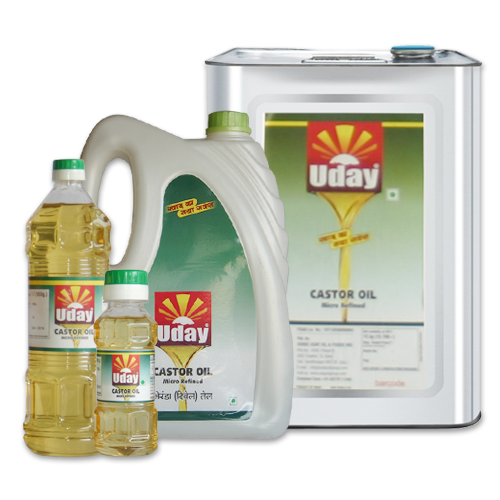
Why Castor Oil Is Unlike Every Other Vegetable Oil
Castor oil in India is not a food oil. That’s the first thing to understand. Unlike groundnut, mustard, or sunflower oil, castor oil is toxic if consumed the castor bean contains ricin, a highly toxic compound. The oil itself, once pressed and processed, doesn’t contain ricin (which stays in the seed meal), but castor oil is still not used for cooking or food processing.
What makes castor oil in India remarkable is its chemistry. It’s approximately 90% ricinoleic acid a hydroxylated fatty acid that gives castor oil unique properties not found in other vegetable oils. It’s extremely viscous. It doesn’t freeze at low temperatures (useful in extreme cold conditions). It has exceptional lubricity. And it’s chemically reactive in ways that make it a building block for hundreds of industrial derivatives.
Where Castor Oil Is Actually Used
The application list for castor oil and its derivatives is genuinely long. Lubrication oils and hydraulic fluids in industries form another major application of the plant – airplanes, ships, and precision machinery have always relied on lubricants based on castor oil due to their wide range of thermal stability. Polymer and plastic manufacture includes castor oil derivatives, especially polyamide-11, that is incorporated into fuel lines, auto components and oil pipes.
Cosmetics industry uses castor oil in lipstick, foundation, hair oil, skin creams, and conditioners for its thickening and conditioning properties. It is a traditional laxative in medicine and serves as a carrier in external medications. In textiles, it acts as a lubricant for fibres. Paints, varnishes, inks, soaps the list continues.
For Indian exporters, castor oil is one of the more reliable revenue streams because global industrial demand for it is structural, not seasonal.
Quality Grades and What Buyers Should Know
Castor oil in India comes in several grades depending on the refining level and intended application. First Special Grade (FSG) is the highest quality, with very low moisture and free fatty acid content, used in food-adjacent applications (as an indirect food additive or in pharmaceutical coatings) and high-grade cosmetics. Commercial Grade is suitable for industrial use where purity is not such an important issue.
Derivative oils that have particular industrial applications include dehydrated castor oil, hydrogenated castor oil, and blown castor oil – dehydrated for paints and varnishes, hydrogenated for cosmetics and candles, blown for lubrication and sealing applications.
The spec sheet for the customer would include specifications for hydroxyl value, acid value, moisture content, colour (Gardner scale), viscosity, and saponification value. An oil vendor that regularly supplies these specifications without having to be asked is working professionally.
India's Castor Oil Export Market
India exports castor oil to over 40 countries. The largest buyers are China, the United States, European nations (Germany, Netherlands, France), Brazil, and Japan. The oil is exported both as crude and as various processed derivatives.
Export quality requirements are strict. The buyers in America and Europe usually lay down maximum limits on acid value, moisture content, and color and insist on getting certificates from independent third-party labs. The key problem for Indian exporters is keeping the quality levels consistent for exports.
Shree Uday Oil, based in Gujarat’s oil-processing heartland, supplies castor oil to international buyers with the documentation and quality consistency that export trade requires.
Castor Oil's Role in Sustainable Industry
There is rising demand for natural products that can replace plastics, lubricants, and polymers produced from petroleum. Castor oil is in an excellent position in this field due to the ability to produce different derivatives using ricinoleic acid. Countries and companies committed to reducing fossil-fuel dependency in industrial supply chains are looking at castor oil derivatives with renewed interest.
For India, this is an opportunity. As the dominant producer of a bio-based industrial feedstock that the world increasingly needs, the castor oil sector has strategic value beyond its current market size.
Uses

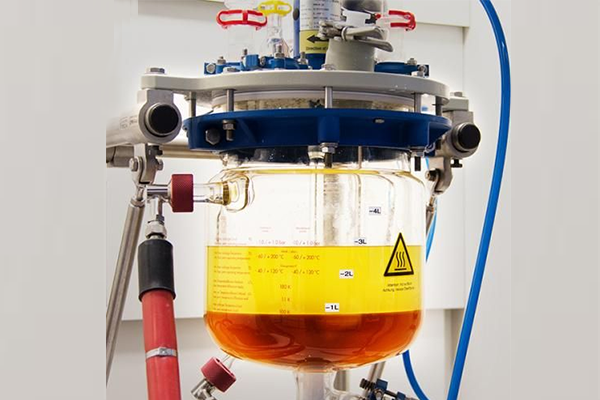

Shree Uday Oil's Castor Oil
Shree Uday Oil supplies castor oil in bulk for industrial, cosmetic, and pharmaceutical applications. Located at Chhatral GIDC, Gandhinagar, and Gujarat one of India’s established industrial processing zones they are well-placed to serve both domestic buyers and export orders with quality documentation.
For specifications, pricing, or export enquiries, contact them at udayoilgroup@gmail.com or call Mr. Vijay Thakkar at +91 9377011342